Quick Summary
Fire protection strategies for industrial facilities are planned sets of measures that prevent fires, detect them quickly, control their spread and protect people and property. They combine building design, equipment, procedures and training, and work best when built on a site-specific fire risk assessment rather than a generic checklist.
- Start with a fire risk assessment that maps ignition sources and combustible materials across the whole site.
- Choose detection and suppression systems against the actual fuel, process conditions and storage height, not a generic occupancy label.
- Connect fire alarms to monitoring so an alarm reaches a responder, not just a panel on a wall.
- Log every system impairment and restore it the same day, with temporary cover arranged in the meantime.
- Give every fire safety action a named owner and a due date, or the plan tends to stall after the first phase.
Table of Contents
- Start With an Industrial Fire Risk Assessment
- Identifying Fire Hazards in Manufacturing Facilities
- Choosing Fire Protection Systems for Industrial Buildings
- Commissioning, Inspection and Keeping Systems Working
- Building a Practical Industrial Fire Safety Plan
- Planning Your Next Step With an Industrial Fire Safety Review
- Frequently Asked Questions
Start With an Industrial Fire Risk Assessment
Last Updated: 5 November 2026
Industrial fires rarely start in obvious places. They start where ignition sources meet combustible materials, often in a corner nobody has looked at for years.
Fire protection strategies for industrial facilities work best when they are built on specifics. A generic checklist can’t tell you where your risk sits. An assessment can.
A fire protection strategy is a planned set of measures that prevents fires, detects them quickly, controls their spread and protects people and property.
Research into industrial fire safety supports this approach. Ouache and co-authors modelled fire safety strategies in a structured way Fire Safety Risk Assessment of Workplace Facilities, Frontiers in Built Environment.
Mapping Ignition Sources and Combustible Materials
Start by walking the site and listing two things: what can ignite, and what will burn. Be thorough.
Common ignition sources in industrial sites include:
- Hot work such as welding, cutting and grinding
- Electrical equipment, panels and overloaded circuits
- Heaters, ovens and process equipment
- Friction from belts, bearings and conveyors
- Static discharge from flammable liquid handling
Combustible materials need the same attention. Look at packaging stores, waste piles, flammable liquids, plastics and combustible dust. Dust is often overlooked. Fine dust settled on ledges and ducts can carry flame much faster than you’d expect.
Watch out: Hot work permits are often signed off on paper and then forgotten. Check the area after welding finishes, not just before it starts.
Identifying Fire Hazards in Manufacturing Facilities
Manufacturing sites carry hazards that offices and warehouses don’t. Process heat, solvents, dust and moving machinery all add risk, and they often interact.
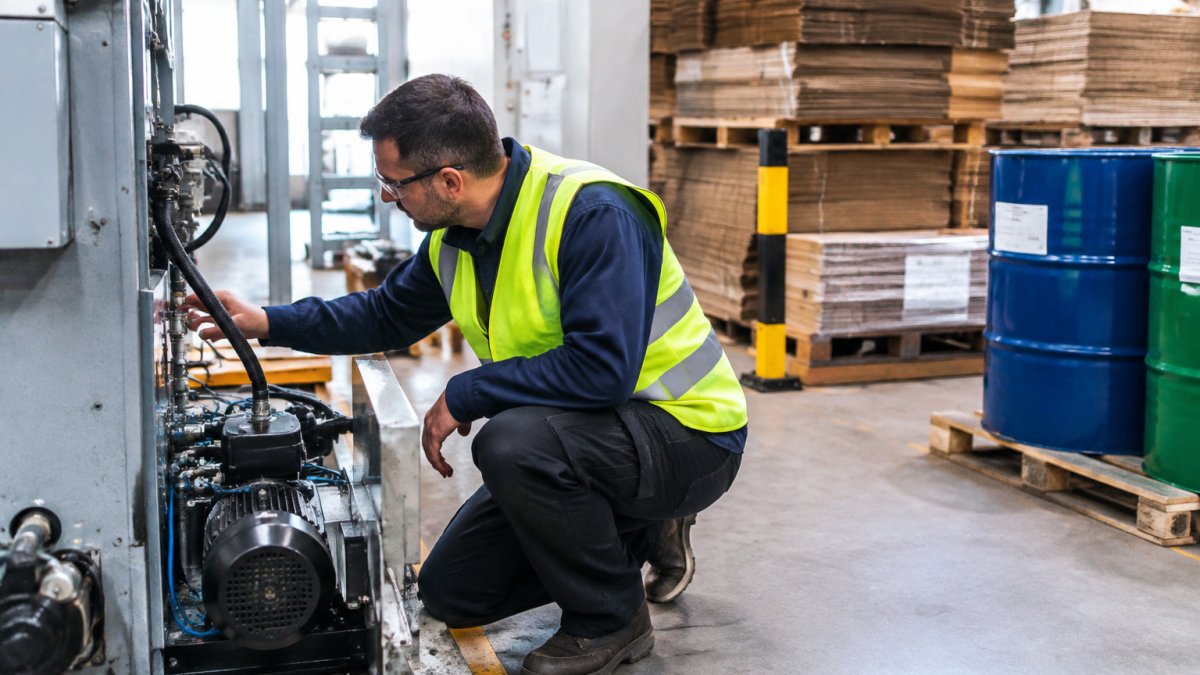
Walk each production area and ask three questions:
- What is being made, heated, mixed or moved here?
- What materials are present in quantity, not just in theory?
- What happens if a fire starts at the worst possible point?
Housekeeping is part of prevention. Keep aisles clear, store waste away from buildings and keep electrical enclosures closed and clean. Good housekeeping is cheap, and it removes fuel before it can burn.
Staff training matters too. Operators who know how to spot a warning sign, such as a hot bearing or a burning smell from a panel, can stop a small fault before it grows.
Choosing Fire Protection Systems for Industrial Buildings
Once you know your risks, you can choose systems that match them. There is no single best system for every facility. A cold store, a paint shop and a data hall each need something different, and the choice should follow from the hazard rather than from a catalogue.
Most industrial buildings combine several layers:
- Passive protection: fire-resistant construction, fire doors and compartmentation that slow spread
- Active detection: smoke and heat detectors matched to the environment
- Suppression: automatic sprinklers for general areas and special systems for high-risk zones
- Management: procedures, drills and an emergency response plan
Matching the System to the Hazard, Not the Label
A risk-based selection starts with four questions about each area: what fuel is present, what process conditions apply, how the space is laid out, and what happens to the business if the area is lost. The answers narrow the options quickly.
- Fuel type. Flammable liquids spread fire across the surface, so foam or a suitable suppression agent may be needed rather than water alone. Combustible dust can be lofted by the very discharge of a suppression system, so agent choice and discharge pressure matter. Ordinary combustibles such as packaging and palletised goods are usually well served by water-based systems.
- Process conditions. A dusty process area will false-alarm a smoke detector designed for a clean office; a heat detector or multi-sensor device is often a better fit. Cold stores and freezers need detection rated for low temperatures and sprinkler designs that account for the environment. Areas with corrosive atmospheres need enclosures and devices rated accordingly.
- Building layout. High ceilings, mezzanines, concealed voids and open plan production all affect detector placement and sprinkler coverage. Compartmentation limits how far a fire can travel and buys time for evacuation and intervention, but only if fire doors and penetration seals are maintained.
- Business continuity. A data hall, control room or critical process line may justify a clean-agent system that protects equipment as well as people, because water damage alone could halt operations. A general warehouse rarely needs that level of protection.
Watch out: Selecting a system from a generic occupancy label rather than the actual commodity and storage height is a common cause of under-designed sprinkler protection.
Detection, Alarm Monitoring and Automatic Sprinklers
Detection only helps if someone hears the alarm and acts on it. Connect your fire alarm system to monitoring so that an alarm reaches a responder, not just a panel on a wall.
Automatic sprinkler systems are a common control for general industrial areas. They respond without waiting for a person, and they limit fire growth while people evacuate.
A common mistake is treating detection and sprinklers as separate projects. They work together, so design them together, and confirm that the alarm and suppression logic does not create conflicting responses.
Special-Hazard Suppression for High-Risk Areas
Some areas cannot be protected well with water. Electrical rooms, flammable liquid stores, server rooms and certain process lines may need gaseous, foam or other special-hazard suppression.
Keep these systems tied to a specific risk assessment.
The article sets out the main factors that should drive the choice of system for each area. For high-risk zones, structural fire engineering support can help design fire-resilient protection.
| Factor | Question to ask | Example from the article |
|---|---|---|
| Fuel type | What fuel is present? | Flammable liquids may need foam rather than water alone |
| Process conditions | What conditions apply? | Dusty areas suit heat or multi-sensor detectors |
| Building layout | How is the space arranged? | High ceilings and mezzanines affect detector placement |
| Business continuity | What if the area is lost? | Data halls may justify a clean-agent system |
Commissioning, Inspection and Keeping Systems Working
A system that works on handover can fail a year later. Commissioning proves that a system performs as designed. Ongoing inspection, testing and maintenance keep it that way.
Plan for these activities:
- Commission each system and record the results
- Test detection and alarm devices on a fixed schedule
- Inspect sprinkler valves, pumps and water supplies
- Log every impairment and restore it as quickly as possible
- Check that changes to the site have not blocked a detector or sprinkler
Impairment management is where many facilities slip. When a sprinkler section is shut down for repair, someone has to arrange temporary cover, notify people and reinstate the system the same day.
Building a Practical Industrial Fire Safety Plan
A practical plan turns the strategies above into steps your team can follow. Most facilities already have a list of recommendations; what they lack is a sequence, named owners and a way to verify that each step actually happened. The plan below is built to close that gap.
Phase 1: Assess and Rank
- Complete the fire risk assessment and rank the hazards by consequence and likelihood, not by how easy they are to fix.
- Record the basis for each ranking so that a later reviewer can see why one area was prioritised over another.
- Assign an owner to the assessment itself, usually the facility manager or a nominated fire safety lead.
Phase 2: Control the Highest Risks First
- Set priority controls for the highest-risk areas first, even if the full programme will take months to complete.
- Document procedures for hot work, housekeeping and waste, and make the hot work permit a live control rather than a signature on a form.
- Confirm that temporary controls are in place wherever a permanent control is delayed.
Phase 3: Design, Commission and Verify
- Choose and commission detection, alarm and suppression systems against the risk assessment, and record the commissioning results.
- Set an inspection and maintenance schedule with named owners and due dates, not just a frequency.
- Train staff and run fire drills, including evacuation procedures, and record attendance and drill performance.
Phase 4: Review and Improve
- Review the plan after every change to the site or process, and at least annually.
- Track the indicators that show whether the programme is working: overdue inspection actions, duration of system impairments, training completion and drill performance.
- Adjust the plan when the indicators move the wrong way, rather than waiting for the next scheduled review.
Watch out: A plan with no named owners and no due dates tends to stall after the first phase, because everyone assumes someone else is progressing it.
Measuring Whether the Programme Is Working
Useful indicators of whether a fire safety programme is working include the count of overdue inspection actions, the total duration of system impairments, training completion rates and drill performance against the expected evacuation time. These are best read together rather than in isolation.
Business continuity matters alongside life safety, since a fire can stop production for an extended period. Plan how you will recover equipment, restore supply and communicate with customers before a fire happens, and identify the critical operations that must be restored first.
Planning Your Next Step With an Industrial Fire Safety Review
If you are unsure where your facility stands, the fastest way forward is a structured review. Fire risk assessment services can identify your highest risks and show which controls to prioritise. If your project involves design changes or new systems, our fire engineering services cover structural and performance-based design. You can also get in touch with FyreWise to talk through your site. Pricing depends on the size and complexity of the facility, so contact us for a quote.
Frequently Asked Questions
What are the main fire hazards in industrial facilities?
The most common hazards in industrial facilities include flammable liquids, combustible dust, hot work such as welding and cutting, electrical faults, and poor housekeeping that lets combustible materials accumulate near ignition sources. Each of these needs a documented control measure. A fire risk assessment identifies which hazards apply to your site, how likely they are to start a fire, and what the consequences would be. Hot work permits, regular housekeeping inspections and planned electrical maintenance are among the most effective first controls to put in place.
How often should industrial fire protection systems be inspected and maintained?
Fire protection systems such as detectors, alarm panels, sprinkler systems and fire doors should be inspected and tested on a documented schedule, with the frequency set by the relevant British Standards and the requirements of your building’s fire safety schedule. Inspection and testing records should be kept on site. Any impairment, such as a sprinkler valve closed for repair, should be managed through a formal process so protection is restored promptly. Your fire engineer or service provider can confirm the schedule that applies to your facility.
What should an industrial fire safety plan include?
An industrial fire safety plan should set out the hazards identified in your risk assessment, the fire protection systems installed, emergency response roles, evacuation procedures and means of escape, and how staff are trained and drilled. It should also describe how fire alarm signals are responded to, how contractors are controlled during hot work, and how the business recovers operations after an incident. Review the plan after any significant change to the facility, process or occupancy, and after each drill or real event.
How can a fire engineering consultant help improve industrial fire safety?
A fire engineering consultant can assess your site’s specific hazards, recommend risk-based protection measures, and check whether proposed designs meet the Building Code of Australia and relevant British Standards. For complex or non-standard facilities, a performance-based approach can deliver effective protection where prescriptive solutions do not fit. Consultants can also support commissioning and performance verification so systems work as designed. Contact FyreWise through our website to discuss your facility and request a quote, as pricing depends on the scope, size and complexity of the project.