Last Updated: 31 October 2026
Quick Summary
A fire risk assessment review should happen regularly and whenever something about the building or its use changes. For many low-rise blocks the guidance is a review every 2 years and a full reassessment every 4 years, with a 12-month cycle widely used as a baseline.
- Many low-rise blocks: review every 2 years, full reassessment every 4 years.
- Professional fire risk assessments are typically revisited every 3 to 5 years, depending on complexity.
- A 12-month cycle is widely used as a sensible baseline but is not automatically the legal standard.
- Bring the review forward after any fire, near miss, layout change, new use or rise in occupants.
- An assessment has no expiry date; it stays valid only while it accurately reflects the building and its risks.
Table of Contents
- How Often a Fire Risk Assessment Should Be Reviewed
- Is There a Fixed Legal Review Interval?
- When to Review a Fire Risk Assessment Before the Scheduled Date
- Fire Risk Assessment After Building Changes
- How Long Is a Fire Risk Assessment Valid For?
- Fire Risk Assessment Review Checklist
- Booking Your Next Fire Risk Assessment Review With FyreWise
- Frequently Asked Questions
How Often a Fire Risk Assessment Should Be Reviewed
A fire risk assessment should be reviewed regularly, and whenever something about the building or its use changes. For many low-rise blocks, the guidance is to review every 2 years and redo the full assessment every 4 years. Tower Hamlets Council guidance on how often a fire risk assessment must be done
The review cycle your building needs depends on its type, age and use.
Many businesses ask whether a yearly review is required. A 12-month cycle is widely used as a sensible baseline, but it is not automatically the legal standard. Some guidance suggests professional fire risk assessments are typically revisited every 3 to 5 years, depending on complexity. general industry guidance on fire risk assessment frequency
Our advice is simple: set a routine review date, then bring it forward whenever the facts change.
The article gives a baseline review cycle for many low-rise blocks, with the triggers that should bring a review forward.
| Review type | Typical interval | Note |
|---|---|---|
| Full review, low-rise blocks | Every 4 years | Full assessment redone |
| Interim review, low-rise blocks | Every 2 years | Check the assessment still holds |
| Professional assessment | Every 3 to 5 years | Depends on complexity |
| Business baseline cycle | Every 12 months | Widely used, not automatic |
| Any significant building change | Immediately | Update the assessment |
Is There a Fixed Legal Review Interval?
No. Australian work health and safety law does not prescribe a single review interval for a fire risk assessment. Because the duty is ongoing, the assessment must stay current, but the law leaves the timing to you, based on the risk and the rate of change.
The framework most premises sit within includes:
The question of how often the law requires a review is answered by the risk itself: whenever the risk changes, and at a frequency your risk management process can justify.
The legal test is not “did we hit the anniversary?” but “can we show the assessment still reflects the building, its occupants and its risks?” If you cannot, the review is overdue regardless of the calendar.
A practical way to set a defensible interval is to document your reasoning: premises risk level, complexity, occupancy profile and how often things change. That record is what demonstrates the duty was met.
When to Review a Fire Risk Assessment Before the Scheduled Date
Waiting for the planned review date is a common mistake. Several events should trigger an early review:
- A fire, or a near miss
- A change to the layout, walls, doors or escape routes
- A new use for part of the building
- More occupants, or a shift in who uses the space
- New equipment or processes that add fire risk
- Changes to fire protection systems or their maintenance
- Findings from an inspection or audit that point to new hazards
Watch out: Some organisations keep a 12-month review on paper but never act on changes between reviews. A fire risk assessment that no longer reflects the building can give false comfort.
Fire Risk Assessment After Building Changes
Building changes are the most common reason an assessment goes out of date. Think about what you have changed since the last review.
A new partition can block an escape route. A reconfigured office can move people into an area that was never assessed. A change of use can bring a higher-risk activity into a low-risk space.
After any significant change, update the assessment. Then record what changed, what you did about it and the new review date.
How Long Is a Fire Risk Assessment Valid For?
An assessment has no expiry date. It remains valid only for as long as it accurately describes the building, the people in it and the fire risks present. The moment any of those diverge from the document, validity ends, even if the review date is months away.
Rather than pick a single interval, set a risk-based review schedule and record why you chose it. A workable method:
- Rate the premises on occupancy (numbers, sleeping risk, vulnerable people), building complexity (height, layout, compartmentation), fire loading and the presence of high-hazard processes.
- Rate the rate of change, fit-outs, tenancy churn, new equipment, seasonal peaks.
- Set the interval so that lower-risk, stable premises sit at the longer end and higher-risk or fast-changing premises sit at the shorter end. The number matters less than the reasoning behind it.
- Add event-based triggers that override the schedule entirely (see the earlier section).
- Bring the date forward whenever a trigger occurs, and reset the clock from the review date.
A review is not the same as a reassessment or a renewal. A review checks whether the existing assessment still holds and updates it where needed. A reassessment rebuilds the assessment from scratch, appropriate after major change, a significant incident, or when the original is clearly out of date. A renewal is simply re-dating a document; on its own it proves nothing.
Evidence to keep after each review. Whatever interval you choose, the record is what makes it defensible. For every review, log:
- the date and the name and competence of the reviewer
- what was checked and what had changed since the last review
- any new hazards or changes to people at risk
- actions identified, the person responsible and the completion deadline
- confirmation that fire safety measures and equipment checks (alarms, emergency lighting, extinguishers, fire doors) are current under AS 1851
- the next scheduled review date and the triggers that would bring it forward
Keep this alongside your fire safety log so the assessment’s history can be traced. An assessment backed by a dated, reasoned review record is far easier to defend than one that simply carries a recent date.
Fire Risk Assessment Review Checklist
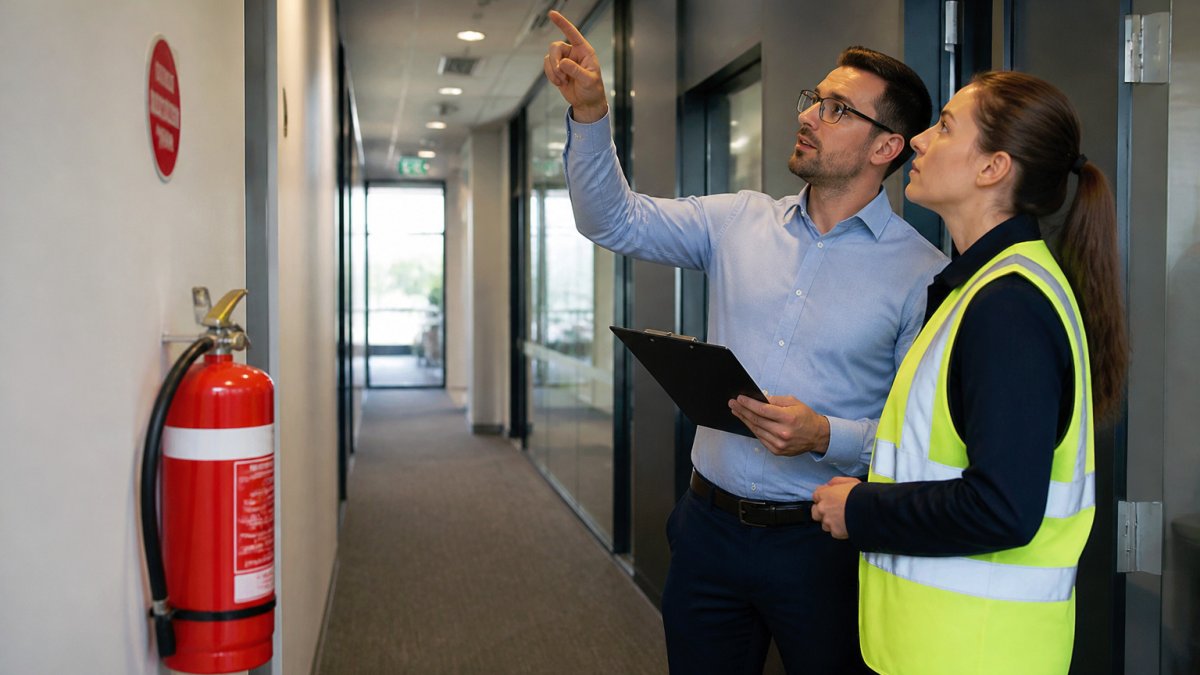
Use this checklist at each review:
- Confirm the building layout matches the assessment
- Check escape routes are clear and signed
- Confirm fire doors close properly
- Check fire extinguishers and alarms are serviced
- Review the occupants and any changes to how the building is used
- Record any near misses or incidents since the last review
- Update the action plan and set the next review date
Keep a dated record of every review, including what changed. This record is your evidence that the assessment stays current.
Booking Your Next Fire Risk Assessment Review With FyreWise
If your building has changed, or your review date is approaching, FyreWise can help.
To get started, send us an enquiry with your building details and the date of your last review.
Frequently Asked Questions
How often should a fire risk assessment be reviewed?
There is no fixed interval written into the Building Code of Australia for every premises, so the review frequency is set by the responsible person based on risk. Many organisations review annually as a baseline, while higher-risk buildings, occupancies with vulnerable people, or premises undergoing frequent change may need more frequent reviews. A review should also happen whenever the building, its use, occupancy or fire safety measures change significantly, regardless of the scheduled date.
How long is a fire risk assessment valid for?
A fire risk assessment does not expire on a set date, but it remains valid only while it still reflects the building and how it is used. If the layout, occupancy, fire safety systems or activities have changed, the assessment may no longer be accurate even if it is recent. Keeping a dated review record shows that the assessment has been checked against current conditions.
What changes should trigger a fire risk assessment review?
Changes that affect escape routes, fire compartmentation, ignition sources, storage of combustible materials, the number or type of occupants, or the fire detection and suppression systems should trigger a review. A near miss or fire incident also calls for an early look at the assessment. Structural alterations or a change of building use are among the most significant triggers, and a fire risk assessment after building changes should be treated as a priority.
Who should review a fire risk assessment?
The responsible person must ensure the review is carried out, and it should be done by someone with the competence to assess fire risk for that type of premises. For complex or performance-based buildings, a chartered or RPEQ-accredited fire engineer can provide the technical input needed. The review should be documented, with the date, the reviewer and any actions arising from it recorded in the fire safety logbook.