
Performance Solution for a Shed Within 900 mm of the Allotment Boundary
A backyard shed is one of the most common additions to a residential property, but positioning it close to the side or rear boundary can create a significant NCC compliance problem.
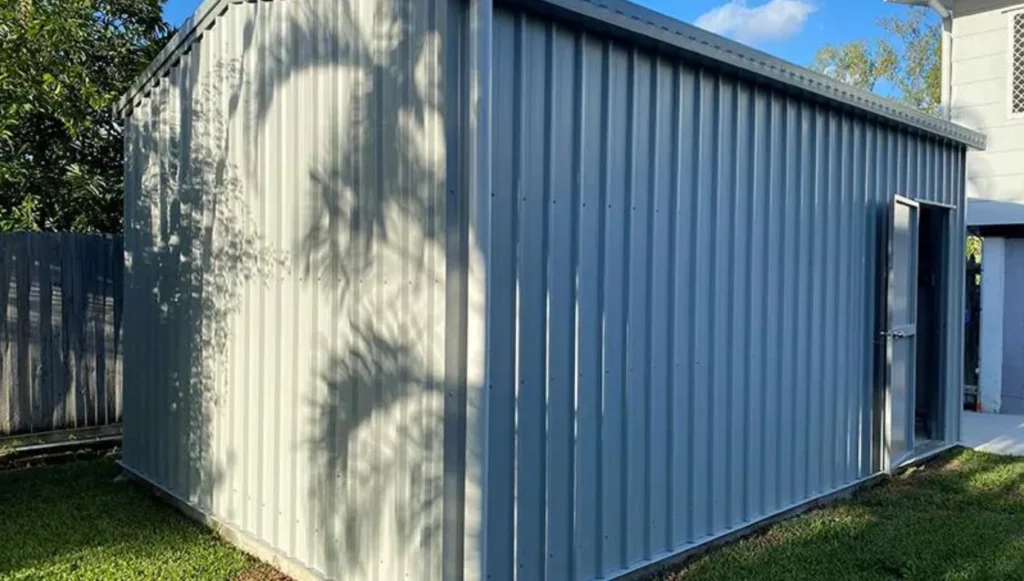
In a recent project, a client had a steel-framed shed constructed within 600 mm of the allotment boundary, well within the trigger distance under the ABCB Housing Provisions. Under Deemed-to-Satisfy (DtS) provisions, this would have required fire-rated construction on the boundary-facing wall of the shed.
Instead, we delivered a compliant Performance Solution that preserved the original design while satisfying the intent of the National Construction Code (NCC).
The Challenge
Clause 9.2.4 of the ABCB Housing Provisions requires that a Class 1 building be protected from fire spread originating in an associated Class 10a building where that structure is positioned close to an allotment boundary.
Clauses 9.2.5 to 9.2.7 generally require fire-rated construction between the allotment boundary and the carport, or between the carport and the associated Class 1a building.
Unlike a carport, a shed has fully enclosed walls. This means:
- It cannot rely on the open carport exemption under Clause 9.2.8.
- It presents a greater risk of internal fire development and radiant heat flux toward the boundary.
- Combustible contents such as fuel, oils, garden equipment, and timber are commonly stored inside.
Under the DtS provisions, the boundary-facing wall of the shed would have required an external wall achieving a Fire Resistance Level (FRL) of 60/60/60, which is structurally and aesthetically impractical for most lightweight steel or timber-framed shed products.
What This Really Means for Homeowners & Builders
Most people assume a standard kit shed can be installed anywhere in the backyard. In practice, unless it is positioned beyond the DtS setback distance from the boundary, the NCC requires fire separation between the shed and the neighbouring allotment to limit fire spread (Performance Requirement H3P1).
For an enclosed shed, this requirement is more stringent than for an open carport, and achieving a fire-rated lightweight shed wall is rarely straightforward.
Our Performance Solution
Our Performance Solution relied on an engineering assessment demonstrating that the proposed design achieved an equivalent level of fire safety to the DtS pathway through the following construction requirements and design constraints:
- Non-combustible wall cladding on all boundary-facing elevations using Colorbond steel sheeting (minimum 0.42 BMT) fixed to a steel frame, providing a non-combustible external skin with no openings facing the boundary.
- Non-combustible steel framing, requiring the shed to be a steel-framed kit (such as ShedBoss, Absco Steel, or an equivalent system) with no combustible structural elements on the boundary-facing elevations.
- No openings on the boundary side, including windows, doors, ventilation louvres, or service penetrations, eliminating direct radiation and flame-impingement pathways toward the neighbouring property.
- Concrete slab floor, providing a non-combustible floor system that limits fire spread at ground level.
- Protection of the associated Class 1a dwelling, where the dwelling wall was within 900 mm of the shed, by upgrading the external wall cladding to James Hardie Scyon or an equivalent non-combustible fibre cement sheeting.
The assessment demonstrated that this combination of non-combustible construction, the absence of boundary-facing openings, and a concrete slab floor achieved an equivalent or better level of fire safety than a DtS FRL 60/60/60 boundary wall in limiting fire spread to neighbouring properties while protecting the associated dwelling.
Have a Similar Boundary or Fire Separation Issue?
Carports, sheds, garages, and outbuildings located within 900 mm of an allotment boundary are among the most common reasons Performance Solutions are required for residential projects across Queensland and Australia.
If you’re facing a similar challenge—or any other NCC compliance issue—our team can help you find a practical, compliant solution.

